API Layer (ServiceDeskLite.Api)
Middleware Pipeline Order (Program.cs)
1.  Serilog configuration (before WebApplication builder)
2.  Services:
      AddApiDocumentation        → OpenAPI + Swagger
      AddApiErrorHandling        → ProblemDetails + ExceptionHandler + Mapper
      AddApplication             → use-case handlers (Scoped)
      AddApiInfrastructure       → persistence provider switch
      AddCors("WebFrontend")     → origins from Cors:AllowedOrigins config
3.  EF Core auto-migration (Postgres only, before app.Build())
4.  app.UseApiRequestLogging()   → Serilog request logging
5.  app.UseApiDocumentation()    → OpenAPI endpoint
6.  app.UseApiErrorHandling()    → UseExceptionHandler()
7.  app.UseApiSecurity()         → ApiKeyMiddleware (X-Api-Key header)
8.  app.UseHttpsRedirection()
9.  app.UseSwagger() / UseSwaggerUI()  → Development only
10. app.UseCors("WebFrontend")
11. Endpoint mapping
In Development, a
ITicketSeederruns on startup to populate the InMemory store with sample data.

Endpoints
Tickets (TicketsEndpoints.cs) — base route group: /api/v1/tickets
| HTTP | Route | Handler | Returns |
|---|---|---|---|
| GET | /api/v1/tickets | SearchTicketsAsync | 200 OK + PagedResponse<TicketListItemResponse> |
| POST | /api/v1/tickets | CreateTicketAsync | 201 Created + CreateTicketResponse |
| GET | /api/v1/tickets/{id:guid} | GetTicketByIdAsync | 200 OK + TicketResponse |
| POST | /api/v1/tickets/{id:guid}/status | ChangeTicketStatusAsync | 200 OK + TicketResponse |
| POST | /api/v1/tickets/{id:guid}/comments | AddCommentAsync | 201 Created + CommentResponse |
| POST | /api/v1/tickets/{id:guid}/assign | AssignTicketAsync | 200 OK + TicketResponse |
| GET | /api/v1/tickets/{id:guid}/audit-events | GetAuditEventsAsync | 200 OK + AuditEventResponse[] |
Dashboard (DashboardEndpoints.cs) — base route group: /api/v1/dashboard
| HTTP | Route | Handler | Returns |
|---|---|---|---|
| GET | /api/v1/dashboard/summary | GetDashboardSummaryAsync | 200 OK + DashboardSummaryResponse |
All errors return RFC 9457 ProblemDetails via ResultToProblemDetailsMapper.
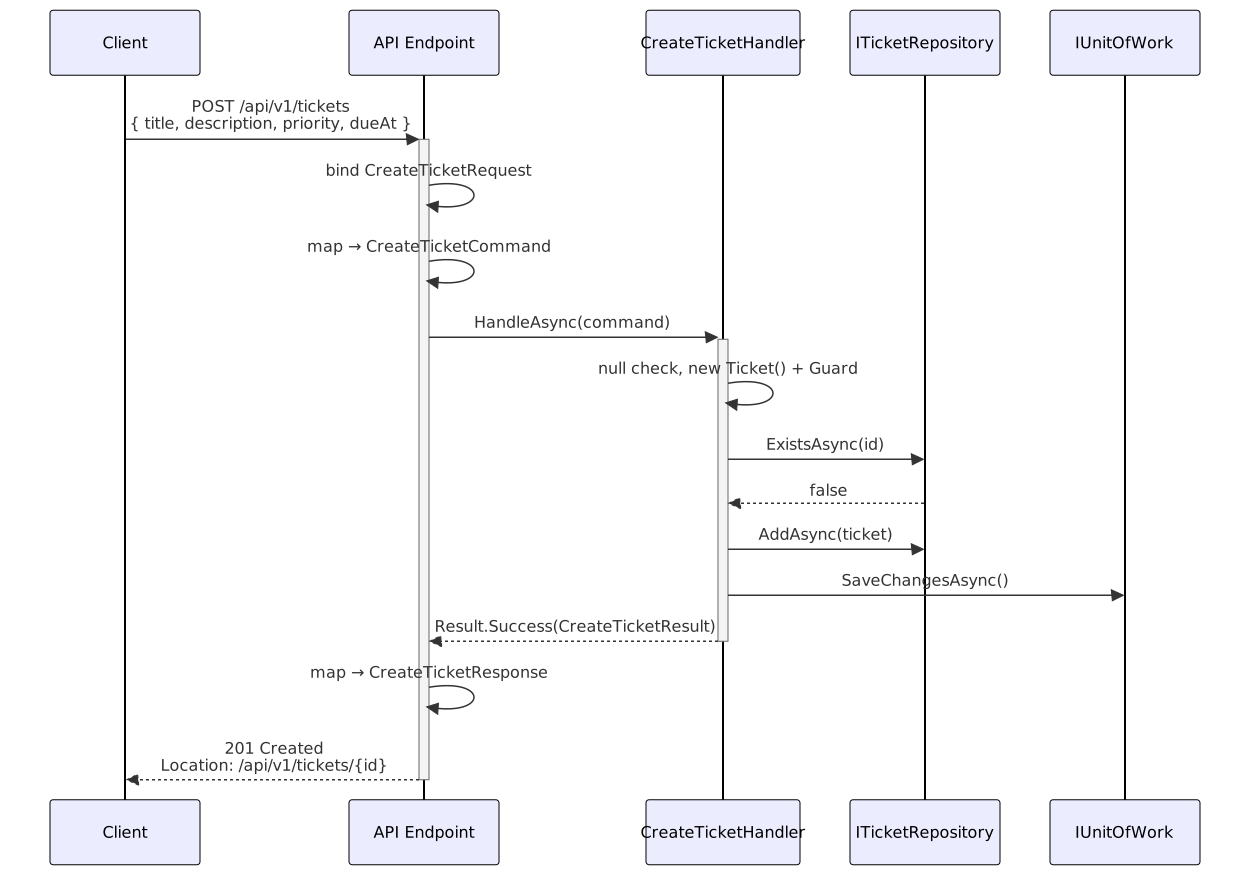
Request Lifecycle
The following sequence covers the POST /api/v1/tickets happy path. All other endpoints follow the same structure.
API Key Authentication (ApiKeyMiddleware)
All API endpoints require an X-Api-Key header (see ADR 0022).
// Slim middleware — runs before all other pipeline stages except logging and error handling.
// Returns 401 Unauthorized (plain, no ProblemDetails body) on missing or invalid key.
// Exempt for OpenAPI/Swagger endpoints in Development.
// Key is read from Auth:ApiKey configuration (injected via environment variable or user secrets).
The Blazor Web frontend forwards the key on every outbound request via ApiKeyDelegatingHandler.
Correlation
public static class Correlation
{
    public static string GetTraceId(HttpContext ctx)
        => Activity.Current?.Id
           ?? ctx.TraceIdentifier
           ?? "unknown";
}
TraceId is attached to every ProblemDetails response as the traceId extension field.
ResultToProblemDetailsMapper
public sealed class ResultToProblemDetailsMapper
{
    public IResult ToHttpResult<T>(
        HttpContext ctx, Result<T> result, Func<T, IResult> onSuccess)

    public IResult ToProblem(HttpContext ctx, ApplicationError error)
}
Uses ApiProblemDetailsFactory to produce RFC 9457 responses with extensions:
code, errorType, traceId, meta.
ResultMappingExtensions
Fluent bridge: result.ToHttpResult(ctx, mapper, value => Results.Ok(value.ToResponse())).
Exception Handling Pipeline
ApiExceptionHandler : IExceptionHandlercatches all unhandled exceptionsExceptionClassification.IsClientBadRequest(ex)→BadHttpRequestException, FormatException, InvalidOperationException→ 400ExceptionClassification.IsCancellation(ex, ctx)→ request cancelled → no response- All other exceptions → 500 Unexpected
Logging: 5xx → ERROR, 409 → WARNING, 400 → WARNING, others → INFO.

Enum Mapping (Api/Mapping/Tickets/TicketEnumMapping.cs)
// Contracts → Domain
public static DomainTicketPriority ToDomain(this TicketPriority value)
public static DomainTicketStatus   ToDomain(this TicketStatus value)

// Contracts → Application
public static AppTicketSortField  ToApplication(this TicketSortField value)
public static AppSortDirection    ToApplication(this SortDirection value)

// Application → Contracts
public static TicketResponse           ToResponse(this TicketDetailsDto dto)
public static TicketListItemResponse   ToListItemResponse(this TicketListItemDto dto)
public static Paging                   ToPaging(this SearchTicketsRequest request)
public static SortSpec?                ToSort(this SearchTicketsRequest request)
public static PagedResponse<TicketListItemResponse>
    ToPagedResponse(this PagedResult<TicketListItemDto> page)
appsettings.json (Production)
{
    "Logging": { "LogLevel": { "Default": "Information", "Microsoft.AspNetCore": "Warning" } },
    "Persistence": { "Provider": "Postgres" },
    "ConnectionStrings": { "ServiceDeskLite": "<injected via environment variable>" },
    "Auth": { "ApiKey": "<injected via environment variable>" },
    "Cors": { "AllowedOrigins": [] },
    "AllowedHosts": "*"
}
appsettings.Development.json
{
    "Logging": { "LogLevel": { "Default": "Information", "Microsoft.AspNetCore": "Warning" } },
    "Persistence": { "Provider": "InMemory" },
    "Auth": { "ApiKey": "dev-api-key" },
    "Cors": { "AllowedOrigins": [ "https://localhost:7023" ] }
}
OpenAPI Contract Snapshot
The API exposes an OpenAPI v1 specification which is:
- Generated from the running Minimal API
- Snapshotted into
docs/api/openapi.v1.json - Rendered via Swagger UI on GitHub Pages
- Verified in CI to detect contract drift
Purpose
This ensures:
- Contract-driven development
- Transparent API surface for consumers
- Deterministic documentation builds
- Early detection of breaking changes
The OpenAPI snapshot acts as a versioned contract artifact between API and Web layer.